
1. Application Background
Traditional smart access control systems mainly rely on technologies such as biometric identification, alarm linkage, and real-time monitoring to provide security. They are widely deployed in factories, financial institutions, medical facilities, public security areas, commercial buildings, and residential environments. However, these solutions still face several key challenges:
- Authorization of carried items often depends on manual inspection, resulting in high labor costs and limited flexibility, without leveraging artificial intelligence for automated decision-making.
- Data must be transmitted over a network, introducing potential risks of cyberattacks and lower security, as well as inherent latency during data transmission and processing.
- Some solutions adopt biometric technologies such as fingerprints or facial recognition, which may lead to security risks related to the leakage of biometric information.
To address these challenges, Nuvoton Technology introduces a smart access control solution based on the edge AI MCU M55M1. By leveraging on-device AI computing, an offline architecture, and image recognition technology, the solution enables safer and more efficient access control.
2. Solution Overview
2.1 Core Functional Logic
The solution captures real-time scene images through a camera module. The M55M1 main control MCU runs an AI model to perform object recognition and controls the access mechanism according to the recognition results, as defined below:
- Scenario 1: A person holds a transparent wafer carrier in front of the camera → Recognized as an “unauthorized carried item” → Access remains closed
- Scenario 2: A person stands empty-handed in front of the camera → Recognized as “no carried item” → Access opens automatically
- Scenario 3: A person holds a black wafer carrier in front of the camera → Recognized as an “authorized carried item” → Access opens automatically
2.2 Hardware Architecture
The core hardware of the solution consists of the “M55M1 main controller + peripheral modules.” The system block diagram and key components are described as follows:
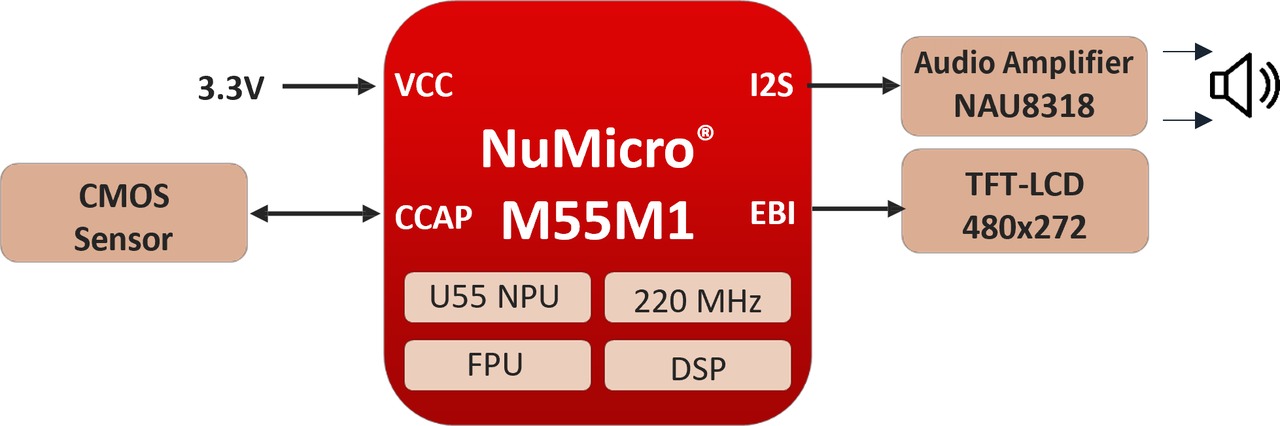
- Main controller: M55M1 AI MCU (integrating the Arm Ethos-U55 NPU), responsible for image reception, AI inference, and access control signal output
- Image capture: CMOS camera module, transmitting image data in real time through the 8-bit parallel camera interface (CCAP) of the M55M1
- Audio prompt: NAU8318 audio amplifier, receiving audio data from the M55M1 via the I2S interface to play voice prompts such as “access opened/closed”
- Display interface: A 480 × 272 resolution TFT-LCD connected via the external bus interface (EBI) to display access status, recognition results, and frame rate information
- Power module: Provides a 3.3 V DC supply for the M55M1, camera, audio amplifier, and display.
2.3 Demo Function Demonstration
The demo implements access control through real-time image capture and AI recognition. The key outputs include:
- Recognition result: When an “8-inch black wafer carrier (8" Black Wafer)” is detected, the corresponding text information is displayed
- Status feedback: The TFT screen shows the “open/close” status of the access control system, while the NAU8318 simultaneously plays voice prompts (e.g., “Access opened”).
3. Key Component: M55M1 AI MCU
3.1 Core Performance Specifications
The M55M1 is a high-performance MCU specifically designed for edge AI applications. Its key specifications include:
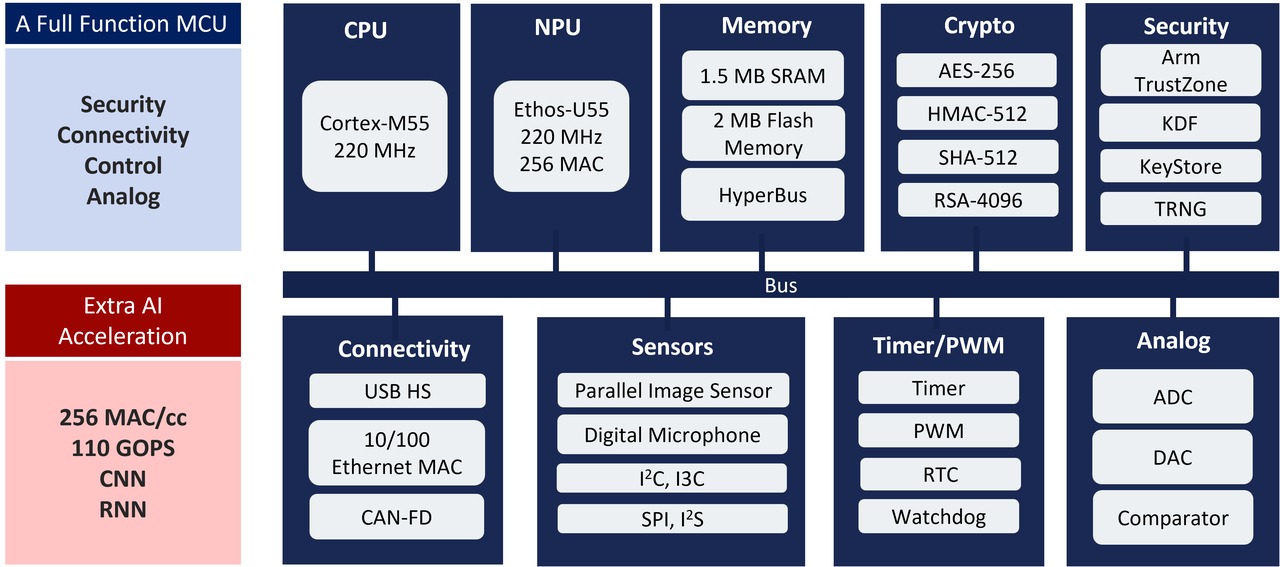
- Processor and computing capability: A 220 MHz Arm® Cortex®-M55 core integrated with a 220 MHz Arm® Ethos™-U55 NPU (110 GOPS). It supports DSP extensions, vector extensions, and an FPU, enabling efficient processing of AI inference and digital signal processing workloads;
- Memory resources: 1.5 MB on-chip SRAM and 2 MB on-chip Flash, with support for OctoSPI and HyperBus interfaces to expand external RAM/Flash;
- Power and environment: Operating voltage from 1.71 V to 3.6 V and operating temperature from -40 °C to +105 °C, suitable for both industrial and consumer applications;
- Security: Supports secure boot, TrustZone hardware isolation, TRNG (true random number generator), key storage, AES-256/SHA-512 cryptographic accelerators, and hardware-level anti-tamper detection, compliant with PSA Level 2 requirements;
- Peripheral interfaces:
- Image capture: One 8-bit parallel camera interface (CCAP);
- Communication: Up to 10× UARTs, 4× SPI/I2S, 4× I2C, 2× CAN-FD, 2× QSPI, one USB 2.0 High-Speed OTG, and one 10/100 Ethernet MAC;
- Analog peripherals: Two 12-bit 5 MSPS SAR ADCs, two 12-bit 1 MSPS buffered DACs, four analog comparators, and one on-chip temperature sensor;
- Control peripherals: 24-channel 200 MHz PWM outputs, four QEI (quadrature encoder interfaces), and four input capture units.
3.2 Key Advantages for Smart Access Control
- On-device AI computing: The Ethos-U55 NPU supports INT8 quantized models and can run YOLO-series object detection models locally, without network connectivity, achieving decision latency ≤ 100 ms;
- High security: Hardware-level encryption and isolation eliminate risks associated with network data transmission and biometric data leakage;
- Rich peripherals: Direct support for camera, display, and audio amplifier modules without additional expansion chips, simplifying hardware design;
- Low power consumption: Local edge processing consumes less power than network-based solutions, making it suitable for long-term standby access control systems.
4. M55M1 Development Flow and Resources
4.1 Development Flow

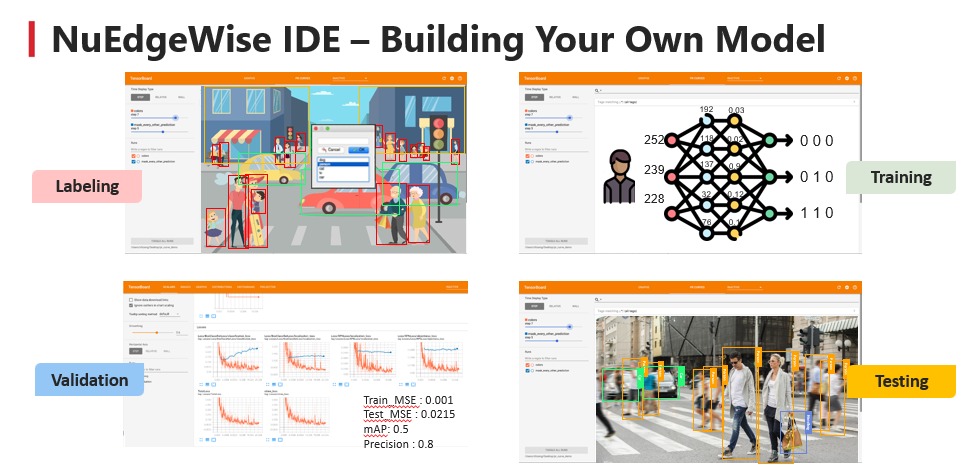
- Model design and training: Developers design object detection models (e.g., YOLOv5s Tiny) using TensorFlow and train them for scenarios such as “wafer carrier / empty hand”;
- Model quantization and optimization: Models are converted using the TFLite Converter with full integer quantization to generate INT8 TFLite models, reducing computational requirements and matching the M55M1 NPU;
- One-click deployment: Using the NuML tool within the Nuvoton NuEdgeWise IDE, INT8 TFLite models are automatically converted into C++ code and integrated into the M55M1 Board Support Package (BSP) for compilation, download, and execution;
- Testing and validation: Real-time images are captured via the camera to validate recognition accuracy and access control logic, while optimizing frame rate and latency.
4.2 Nuvoton Development Resources
Nuvoton provides a complete toolchain and documentation to lower the development barrier:
- NuEdgeWise IDE: An integrated development environment for TinyML, supporting the full workflow from data labeling to model training, validation, and testing, with TensorFlow Lite development interfaces provided via Jupyter Notebook;
- BSP and drivers: A complete M55M1 BSP including drivers for camera, display, and audio amplifier peripherals;
- Reference projects: Smart access control demo source code, including YOLO model deployment examples and peripheral control logic;
- Technical support: Model optimization guides, hardware design references, and FAQs to assist developers throughout the development process.
5. Contact and Collaboration
For more information about the smart access control solution based on the M55M1, please visit Nuvoton’s AI information page at https://www.nuvoton.com/ai/ or contact Nuvoton Technology for collaboration opportunities.